

In high-pressure emergency scenarios, every second counts. Whether in the back of an ambulance, an ER trauma bay, or a battlefield, first responders and medical professionals rely on clear visualization during intubation to save lives. But a persistent challenge has plagued airway management for years—lens contamination from blood, vomit, or mucus1-2.
The Problem: When Visibility Fails, Patients Suffer
Up to 40% of pre-hospital airways experience lens obstruction during intubation. Traditional video laryngoscopes become ineffective when the camera is compromised, forcing providers to remove the device, wipe the lens manually, and reattempt intubation—wasting precious seconds. These delays can lead to hypoxia, failed airway attempts, and increased mortality3-5.

IntuBlade Demonstration
Watch Drew from Chinook Medical Gear demonstrate the features of the new IntuBlade Video/Lens-Clearing Laryngoscope. CLICK to WATCH
The Solution: A First-of-Its-Kind Lens-Clearing Technology
IntuBlade is the only video laryngoscope with a built-in saline spray mechanism, ensuring uninterrupted visualization during intubation. With a simple push of a button, clinicians can clear debris from the camera lens in real-time—no interruptions, no costly delays.
This groundbreaking innovation, inspired by battlefield medicine, eliminates a major obstacle in airway management and enhances first-pass success rates. According to a peer-reviewed study in the American Journal of Emergency Medicine, IntuBlade reduces intubation times by up to 12 seconds compared to hyperangulated video laryngoscopes in clean airway scenarios and by 9.6 seconds in soiled airways6.
Clinician-Tested, Mission-Approved
Medical professionals across emergency medicine and military settings are already seeing the impact of IntuBlade:
“You can’t afford to lose your view of the airway in the middle of an intubation, especially when seconds count. The lens-clearing spray keeps your field of vision clear, and that’s critical—whether you’re in a hospital or out in the field.”
— Dr. Benjamin Fedeles, Assistant Professor, University of Cincinnati & USAF Major 7
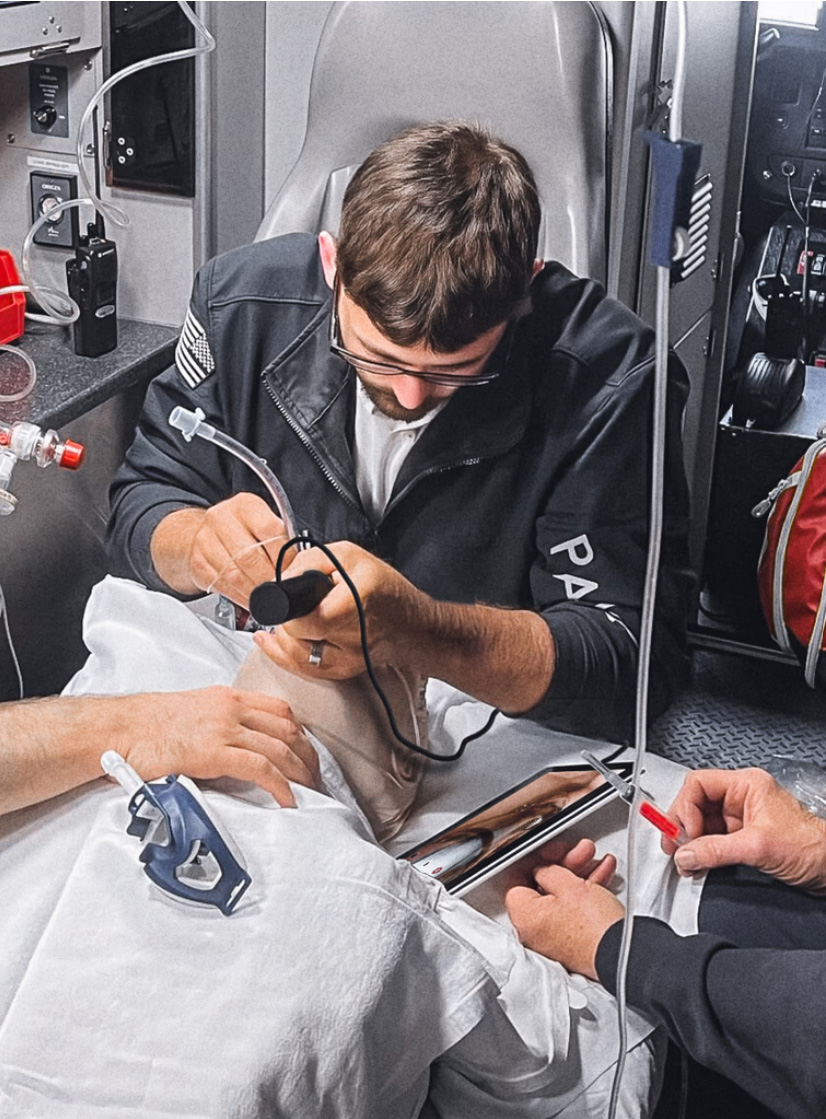
“This device goes one step beyond a normal video laryngoscope, solving the largest problem that has limited VL adoption. It is revolutionary.”
— Dr. C. Hagen, Emergency Medicine Physician
Beyond the Features: IntuBlade’s Impact
While lens-clearing technology is a game-changer, IntuBlade also offers key advantages over traditional video laryngoscopes:
🔹 Fully Disposable: Reduces cross-contamination risk and eliminates costly reprocessing.
🔹 No Battery Required: Powered directly through a USB-C connection, eliminating concerns about dead batteries.
🔹 Standard Geometry: Familiar Macintosh blade design ensures seamless transition for clinicians
trained in direct laryngoscopy.
🔹 Cloud-Based Documentation: Free mobile app enables video recording and real-time quality assurance.

Backed by Research, Designed for the Frontlines
IntuBlade is more than an innovation—it’s a necessity. With FDA clearance and clinical validation, it’s already transforming airway management in EMS, military, and hospital settings.
Join the Movement
For EMS agencies, hospital ERs, and military medics, IntuBlade offers a proven, life-saving solution. If you’re looking to improve first-pass success rates and eliminate delays caused by lens obstruction, now is the time to integrate IntuBlade into your airway management protocols.
Because your mission is clear.
Elevate your teams emergency response and order IntuBlades today at Intublade | Chinook Medical Gear
“This device goes one step beyond a normal video laryngoscope, solving the largest problem that has limited VL adoption. It is revolutionary.”
— Dr. C. Hagen, Emergency Medicine Physician

References
- Platts-Mills, T. F., Campagne, D., Chinnock, B., & Brown, C. A. (2011). Videolaryngoscopy improves intubation success rates among emergency department patients with difficult airway predictors. Annals of Emergency Medicine. https://pubmed.ncbi.nlm.nih.gov/21911279/
- Driver, B. E., Prekker, M. E., Klein, L. R., et al. (2017). Effect of use of a bougie vs endotracheal tube and stylet on first-attempt intubation success among patients with difficult airways undergoing emergency intubation: A randomized clinical trial. Academic Emergency Medicine. https://onlinelibrary.wiley.com/doi/10.1111/acem.13160
- Wong, A., Charbonney, E., & McGuigan, P. J. (2023). The impact of preoxygenation strategies on peri-intubation hypoxemia in critically ill patients: A systematic review and meta-analysis. Critical Care. https://pmc.ncbi.nlm.nih.gov/articles/PMC10029275/
- Russotto, V., Myatra, S. N., Laffey, J. G., et al. (2018). Intubation practices and adverse peri-intubation events in critically ill patients from 29 countries: Insights from the INTUBE study. The Lancet Respiratory Medicine. https://pmc.ncbi.nlm.nih.gov/articles/PMC6322012/
- Mosier, J. M., Sakles, J. C., Law, J. A., & Brown, C. A. (2020). Tracheal intubation in the critically ill: An updated report of complications associated with intubation and insights into approaches to prevention and management. Critical Care Medicine. https://pmc.ncbi.nlm.nih.gov/articles/PMC7214321/
- American Journal of Emergency Medicine. (2021). Decreased time to intubation by experienced users with a new lens-clearing video laryngoscope in a simulated setting. Elsevier. https://doi.org/10.1016/j.ajem.2021.02.028
- Fedeles, B. (2024). Transforming Airway Management with Dr. Benjamin Fedeles. IntuBlade Case Study.